
Designing a Scalable Digital Marketing Campaign Ecosystem
SHRM, the world’s largest HR organization, runs concurrent marketing campaigns across print, web, email, social, television, and paid media to drive membership revenue, event registrations, and sales of professional development products.
Landing pages and microsites were the primary driver of conversions at SHRM. However, their SharePoint-based web ecosystem was designed for editorial publishing rather than scalable digital campaign production. As a result, landing page creation was slow, inconsistent, and required ongoing developer support to resolve technical issues and designer intervention to maintain design and brand consistency.
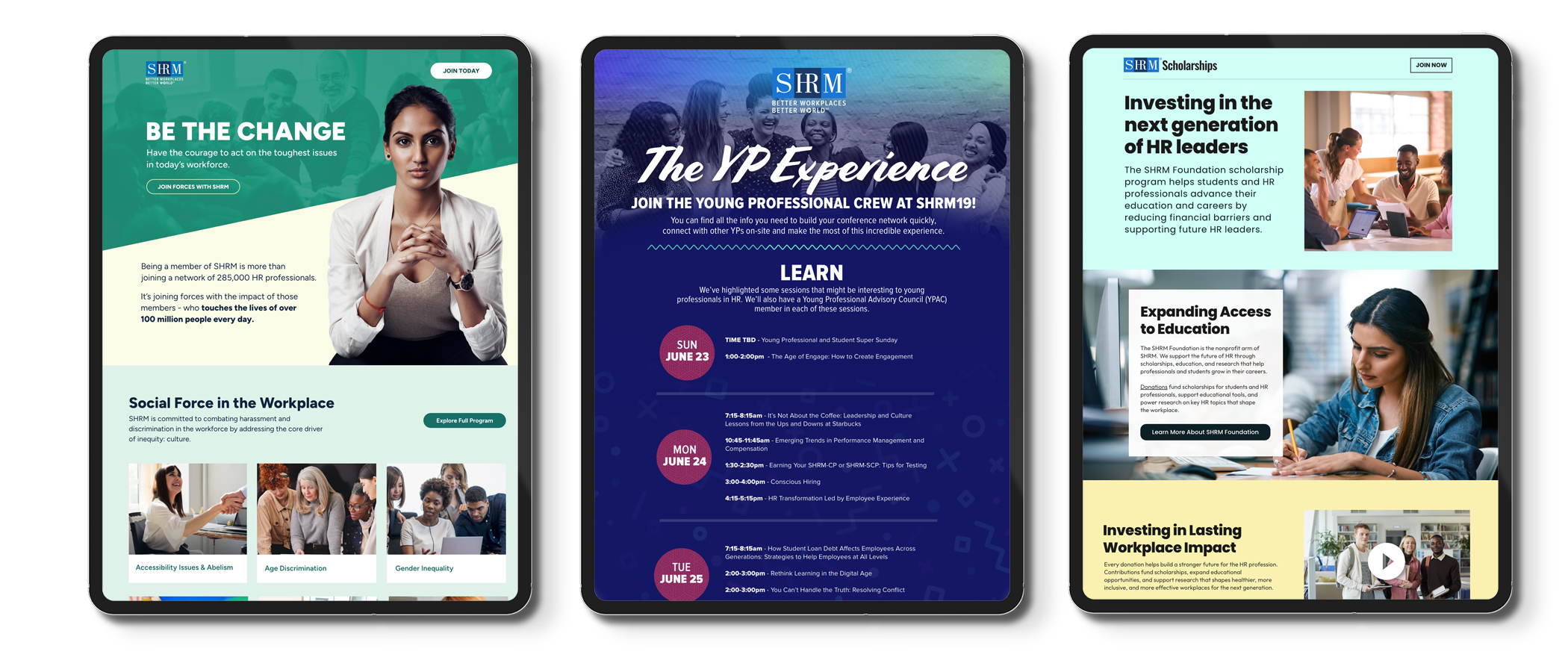
As lead interactive designer at SHRM, I proposed a bespoke landing page builder, a modular design system, and a refreshed digital brand framework. This approach enabled marketing teams to rapidly launch high-performing, on-brand campaign pages without relying on development bottlenecks or constant design oversight.
This was not a landing page redesign. This is a shift from tedious static page production to a scalable digital marketing infrastructure.
Identifying issuesA CMS Built for Content, Not Campaigns
The existing system made it difficult to rapidly create and deploy high-performing landing pages.
Marketing teams faced:
- Slow, multi-step publishing workflows
- Inconsistent layouts and brand expression
- Heavy reliance on technical support for updates and fixes
- Fragile drag-and-drop and WYSIWYG tooling that often introduced more maintenance overhead than efficiency
Instead of enabling speed, the system introduced friction—turning landing page production into a bottleneck in campaign execution.
A CMS Built for Content, Not CampaignsDesigning a seamless experience for users and editors
A second, compounding issue was the nature of the tooling itself. Existing WYSIWYG and drag-and-drop platforms offered surface-level flexibility but lacked meaningful governance. The core problem was not the absence of tooling, but the absence of structured flexibility.
These systems also did not adequately account for SHRM’s security and compliance requirements and often failed to integrate smoothly with existing enterprise infrastructure, including SSO authentication and role-based access controls.
While these systems allowed non-technical users greater freedom, that freedom was not bounded by design or brand constraints. As a result:
- Layout consistency broke down across campaigns
- Brand integrity degraded over time
- QA cycles and rework increased as issues accumulated downstream
The key insight here was that in digital marketing campaigns rigidity and lack of control can both fail for different reasons. Overly rigid systems slow marketing execution, while overly permissive systems introduce inconsistency, technical debt, and ongoing maintenance cost.
SHRM needed a system that balanced both forces: flexibility for marketers, and structured constraints to preserve brand integrity and system reliability.
Finding a SolutionCrafting A Modular Landing Page System + Brand Refresh
The solution introduced a unified system composed of three layers:
Modular Landing Page Builder
A component-based builder enabling marketers to assemble pages using pre-approved, responsive modules of common UI components and widgets specific to SHRM products.
This provided a scalable component library defining layout patterns, UI behaviors, and reusable campaign structures, reducing decision fatigue and ensuring consistency.
Measuring ImpactA Scalable Campaign Engine That Drives Conversions
The new system shifted SHRM from ad-hoc landing page creation to a reusable campaign infrastructure model.
Key outcomes:
- Faster campaign launch cycles through self-serve page creation
- Reduced dependency on engineering and design for routine updates
- Improved brand consistency across campaigns and channels
- Scalable reuse of components across multiple initiatives